
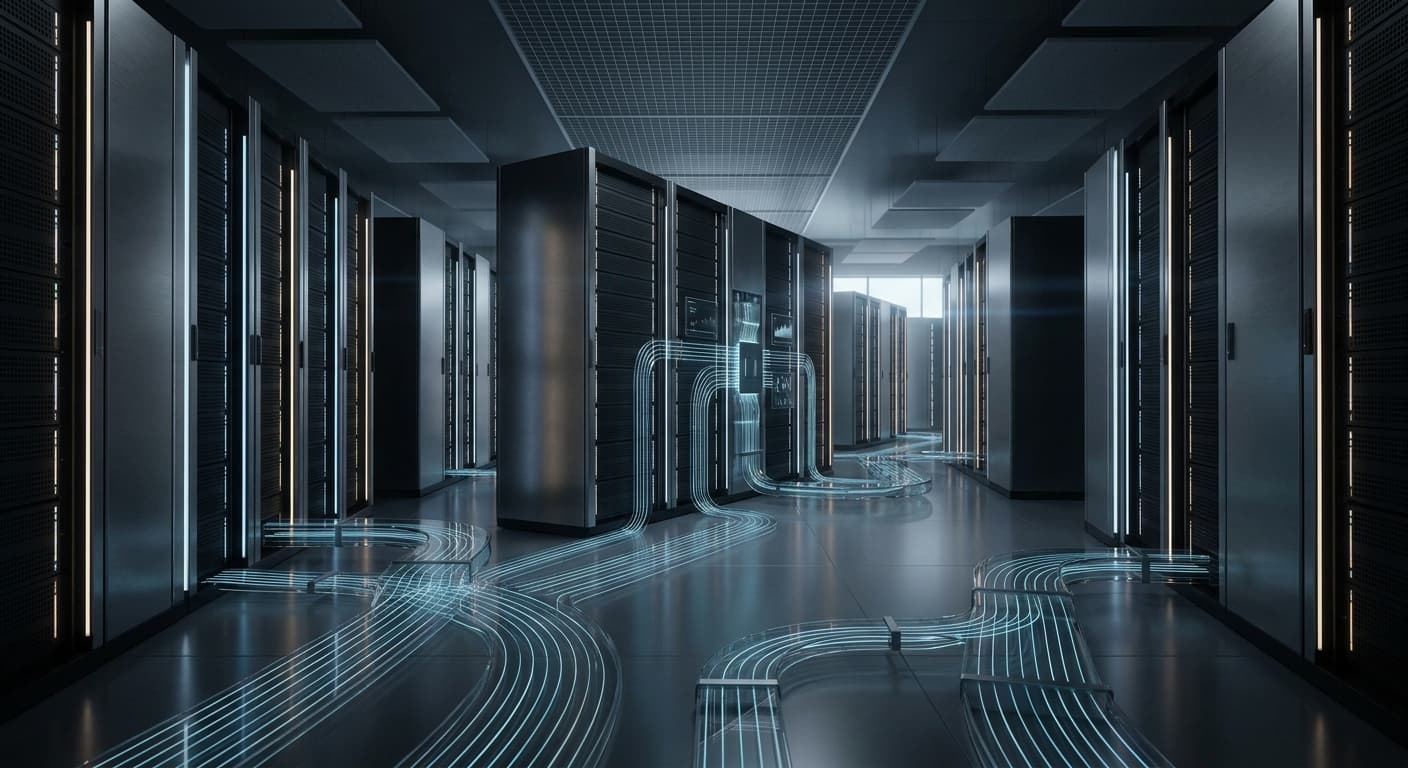
A comprehensive mathematical and architectural breakdown of deep neural networks: Multi-Head Attention derivations, RoPE positional embeddings, KV-cache memory dynamics, and backpropagation mechanics.
1. The Mathematical Foundations of Universal Approximation
Artificial neural networks are parametric non-linear function approximators capable of learning representations across high-dimensional topological manifolds. At their core, modern deep architectures represent compositions of affine transformations followed by non-linear activations:
$$f(x) = \sigma(W_L \cdot \sigma(W_{L-1} \dots \sigma(W_1 x + b_1) \dots + b_{L-1}) + b_L)$$
While early multi-layer perceptrons (MLPs) struggled with vanishing gradients and spatial/temporal invariance, the modern Transformer architecture revolutionized representation learning through Multi-Head Self-Attention.
┌────────────────────────────────────────────────────────────────────────┐
│                   TRANSFORMER ATTENTION MECHANISM                      │
└────────────────────────────────────────────────────────────────────────┘
 Input Token Embeddings (X)
             │
             ├──► [ Linear Projection W_Q ] ──► Queries (Q) ──┐
             ├──► [ Linear Projection W_K ] ──► Keys (K) ────┼──► [ Q · K^T / sqrt(d_k) ]
             └──► [ Linear Projection W_V ] ──► Values (V) ──┤            │
                                                             │            ▼
                                                             │     [ Softmax Mask ]
                                                             │            │
                                                             └────► [ MatMul with V ]
                                                                          │
                                                                          ▼
                                                                [ Multi-Head Output ]
2. Derivation of Scaled Dot-Product Attention
Given an input sequence $X \in \mathbb{R}^{N \times d_{\text{model}}}$, we project $X$ into Query, Key, and Value spaces using learned weight matrices $W_Q, W_K, W_V \in \mathbb{R}^{d_{\text{model}} \times d_k}$:
$$Q = X W_Q, \quad K = X W_K, \quad V = X W_V$$
The attention score matrix is computed via the dot product of $Q$ and $K^T$, scaled by $\frac{1}{\sqrt{d_k}}$ to prevent gradient vanishing in large dimensions where dot products grow large:
$$\text{Attention}(Q, K, V) = \text{softmax}\left(\frac{Q K^T}{\sqrt{d_k}} + M\right) V$$
where $M$ is an optional causal mask ensuring autoregressive models cannot attend to future tokens.
# Production Scaled Dot-Product Attention in PyTorch
import torch
import torch.nn as nn
import torch.nn.functional as F

class MultiHeadAttention(nn.Module):
    def __init__(self, d_model: int = 4096, num_heads: int = 32):
        super().__init__()
        assert d_model % num_heads == 0, "d_model must be divisible by num_heads"
        self.d_model = d_model
        self.num_heads = num_heads
        self.head_dim = d_model // num_heads

        self.q_proj = nn.Linear(d_model, d_model, bias=False)
        self.k_proj = nn.Linear(d_model, d_model, bias=False)
        self.v_proj = nn.Linear(d_model, d_model, bias=False)
        self.out_proj = nn.Linear(d_model, d_model, bias=False)

    def forward(self, x: torch.Tensor, mask: torch.Tensor = None) -> torch.Tensor:
        batch_size, seq_len, _ = x.shape

        # Linear projections & split into heads: [B, H, S, D_k]
        q = self.q_proj(x).view(batch_size, seq_len, self.num_heads, self.head_dim).transpose(1, 2)
        k = self.k_proj(x).view(batch_size, seq_len, self.num_heads, self.head_dim).transpose(1, 2)
        v = self.v_proj(x).view(batch_size, seq_len, self.num_heads, self.head_dim).transpose(1, 2)

        # Scaled dot-product: [B, H, S, S]
        scores = torch.matmul(q, k.transpose(-2, -1)) / (self.head_dim ** 0.5)

        if mask is not None:
            scores = scores.masked_fill(mask == 0, float("-inf"))

        attn_weights = F.softmax(scores, dim=-1)
        context = torch.matmul(attn_weights, v) # [B, H, S, D_k]

        # Concatenate heads & project output
        context = context.transpose(1, 2).contiguous().view(batch_size, seq_len, self.d_model)
        return self.out_proj(context)
3. Rotary Position Embeddings (RoPE)
Unlike absolute positional encodings that assign static vectors to token positions, Rotary Position Embeddings (RoPE) rotate Query and Key representations in 2D complex vector planes. This mathematical formulation naturally incorporates relative distance properties:
$$\langle R_{\Theta, m}^d q, R_{\Theta, n}^d k \rangle = g(q, k, m - n)$$
RoPE allows modern LLMs (Llama 3, Mistral) to generalize gracefully to long context windows (128k+ tokens) using frequency scaling techniques (YaRN).
4. KV-Cache Memory Dynamics & PagedAttention in vLLM
During token generation, recomputing Key and Value matrices for historical tokens at every forward pass is computationally prohibitive.
By caching Key and Value tensors in GPU VRAM (KV-Cache), generation complexity drops from $O(N^2)$ to $O(N)$ per token. However, standard contiguous memory allocation results in 60% to 80% memory fragmentation.
TechBrid implements PagedAttention (inspired by virtual memory paging in operating systems), allocating non-contiguous physical GPU memory blocks on demand, boosting concurrent inference throughput by 3.2x:
5. Architectural Checklist for Large-Scale AI Inference
- [ ] FlashAttention-2 Kernel Integration: Enable Triton / CUDA accelerated attention in production serving engines.
- [ ] RoPE Frequency Calibration: Apply NTK-aware scaling when extending context limits beyond base pretraining.
- [ ] Continuous Tensor Parallelism: Shard matrix multiplications across NVLink-connected GPUs for models exceeding 30B parameters.
- [ ] Quantized KV-Cache (FP8 / INT8): Cut cache memory footprint in half to double concurrent request capacity.
Related Research
View all insights ↗
How can I get started with Artificial Intelligence for my business?
/ AI Engineering / Enterprise AI /
How Natural Language Processing is revolutionizing Text Analysis
/ AI Engineering / NLP & Search /
AI and Robotics: Advancing Automation and Human-Robot Collaboration
/ Edge AI & Robotics / Autonomous Systems /